
QSFP-40G-LR4 40G QSFP+ LR4 1310nm (CWDM4) 10km LC SMF DDM Transceiver Module
-
Uncooled CWDM DFB lasers, directly modulated
-
Fiber connector: SMF LC duplex connector
-
Power dissipation < 3.5W
1 Features
Duplex LC connector
Hot-pluggable QSFP+ form factor
Operating data rate up to11.3Gbps per Lane
Up to 10km transmission
Maximum 3.5W operation power
Compliant with IEEE 802.3ba Compliant with SFF 8436
Built-in Digital Diagnostic Monitoring (DDM) functions
Complies with RoHS directive (2002/95/EC)
Single +3.3V power supply operating
2 Applications
40GBASE-LR4 40G Ethernet
3 Optical Characteristics
Transmitter Characteristics
|
Parameter |
Symbol |
Min. |
Typ. |
Max. |
Unit |
Note |
|
Signal Speed per lane |
Sp |
|
10.3125 |
|
Gbps |
|
|
Center Wavelength |
l |
1264.5 |
1271 |
1277.5 |
nm |
Lane0 |
|
1284.5 |
1291 |
1297.5 |
nm |
Lane1 |
||
|
1304.5 |
1311 |
1317.5 |
nm |
Lane2 |
||
|
1324.5 |
1331 |
1337.5 |
nm |
Lane3 |
||
|
Spectral Width (-20dB) |
Dl |
- |
- |
1 |
nm |
|
|
Side Mode Suppression Ratio |
SMSR |
30 |
- |
- |
dB |
|
|
Total Output Optical Power |
Pot |
|
|
8.3 |
dBm |
|
|
Average Optical Output Power |
Po |
-7 |
- |
2.3 |
dBm |
|
|
Optical Modulation Amplitude, Each Lane |
OMA |
-4 |
|
3.5 |
dBm |
|
|
Extinction Ratio |
Er |
3.5 |
- |
- |
dB |
|
|
Differential Input Impedance |
- |
80 |
100 |
120 |
Ω |
|
|
Differential Data Input Swing |
VINPP |
120 |
|
1000 |
mV |
|
Receiver Characteristics
|
Parameter |
Symbol |
Min. |
Typ. |
Max. |
Units |
Notes |
|
Wavelength of Operation |
l |
1264.5 |
1271 |
1277.5 |
nm |
Lane0 |
|
1284.5 |
1291 |
1297.5 |
nm |
Lane1 |
||
|
1304.5 |
1311 |
1317.5 |
nm |
Lane2 |
||
|
1324.5 |
1331 |
1337.5 |
nm |
Lane3 |
||
|
Optical Input Power, each lane |
Pin |
-13.7 |
- |
2.3 |
dBm |
4.4.1 |
|
Damage Threshold |
Pmax |
- |
- |
3.3 |
dBm |
|
|
Receiver Sensitivity (OMA), each Lane |
Rxsen |
|
|
-11.5 |
dBm |
|
|
Differential Data Output Swing |
VOUTPP |
350 |
|
800 |
mV |
|
Note4.4.1: Measured with 10.3125Gbps, BER=1x10-12
Digital Diagnostic Monitoring Characteristics
|
Parameter |
Symbol |
Range |
Accuracy |
|
Transceiver Case Temperature |
T |
Measured transceiver case temperature over specified operating range |
±3°C |
|
Supply Voltage |
Vcc |
Internally measured transceiver supply voltage ,3.0~3.6V |
±3% |
|
TX Bias Current |
Id |
Measured TX Bias current in uA |
±10% |
|
TX Output Power |
Po |
Measured TX Output Power in dBm Over the specified output power range |
±3dB |
|
Received Optical Power |
Pi |
Measured RX Received Power in dBm Over the specified input power range |
±3dB |
4 Pin Definitions
Pin Diagram
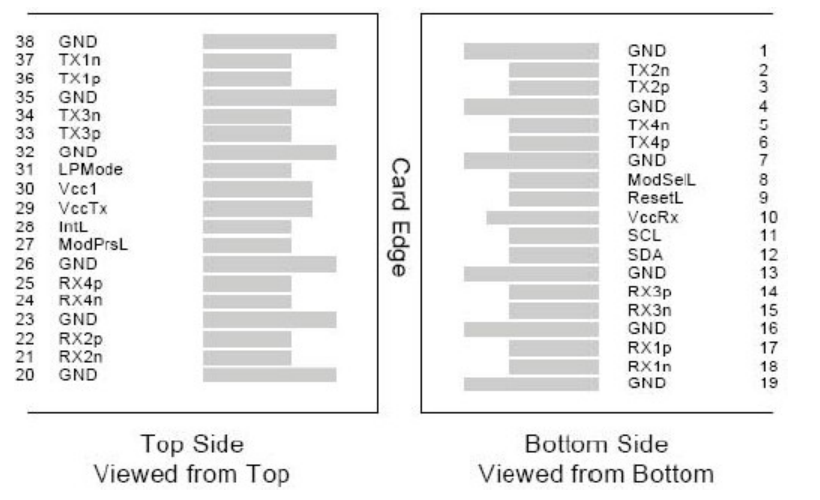
Pin Descriptions
|
Pin# |
Logic |
Name |
Function |
Notes |
|
1 |
|
GND |
Ground |
|
|
2 |
CML-I |
Tx2n |
Transmitter Inverted Data Input |
|
|
3 |
CML-I |
Tx2p |
Transmitter Non-Inverted Data output |
|
|
4 |
|
GND |
Ground |
|
|
5 |
CML-I |
Tx4n |
Transmitter Inverted Data Input |
|
|
6 |
CML-I |
Tx4p |
Transmitter Non-Inverted Data output |
|
|
7 |
|
GND |
Ground |
|
|
8 |
LVTLL-I |
ModSelL |
Module Select |
|
|
9 |
LVTLL-I |
ResetL |
Module Reset |
|
|
10 |
|
VccRx |
+3.3V Power Supply Receiver |
|
|
|
Pin# |
Logic |
Name |
Function |
|
31 |
LVTTL-I |
LPMode |
Low Power Mode |
|
|
32 |
|
GND |
Ground |
|
|
33 |
CML-I |
Tx3p |
Transmitter Non-Inverted Data Input |
|
|
34 |
CML-I |
Tx3n |
Transmitter Inverted Data Output |
|
|
35 |
|
GND |
Ground |
|
|
36 |
CML-I |
Tx1p |
Transmitter Non-Inverted Data Input |
|
|
37 |
CML-I |
Tx1n |
Transmitter Inverted Data Output |
|
|
38 |
|
GND |
Ground |
5 Ordering Information
|
Part Number |
Operating Case Temperature |
RoHS Compliant |
|
HD-QSFP+/40G-LR4 |
0 ~ 70 °C |
RoHS-6 |
|
HD-QSFP+/40G-LR4-I |
-40 ~ 85 °C |
RoHS-6 |

6 Document History
|
Version |
Change Description |
Changed by |
Date |
|
VER A |
Initial Release |
Wang Xin |
01/15/2021 |
Need Help? Contact Our Product Experts or Sales Team Today!
Related Products


Latest News & Blog

-
2025-08-05
Application and Advantages of 1×9 Optical Transceivers in Industrial Printing Systems
As industrial automation and smart manufacturing continue to evolve, communication systems within industrial printing equipment are shifting from traditional copper-based connections to more reliable fiber-optic solutions. Among various optical transmissi

-
2025-08-05
Application of Optical Modules in Mesh Network Topology
Consider employing a mesh network topology to meet your communication and data transmission needs. In this article, we will focus on the application of optical modules in mesh networks to help you better understand this critical technology. 1. High-Speed

-
2025-08-05
Unlocking the Future of Connectivity with OTN Technology
In todays rapidly evolving digital landscape, the need for reliable and efficient data transmission has never been more crucial. Enter Optical Transport Networks (OTN), a technology that is poised to revolutionize the way we connect and communicate. In th


